











BME, an Omnia Holdings company, is reimagining blasting by harnessing the vast amounts of operational data generated across the mining supply chain to support better decisions and create measurable business value through artificial intelligence (AI).
“We are using this wealth of information to generate insights that can support better decision-making across the blasting process,” said Nishen Hariparsad, GM: Technology and Marketing at BME, during the company’s webinar, “Reimagining Blasting: Unlocking Digital Mining Value Through AI-Enabled Solutions.”
He said BME’s approach goes beyond facilitating AI-enabled blasting, towards what he described as “integrity-enabled AI”. “Our solutions are built on trusted and validated operational data, transparent in how it is generated, aligned with safe and responsible mining practices, and designed to support human decision-making,” he said.
For BME, the value of AI ultimately lies not in replacing expertise, but in giving experienced mining professionals better information on which to apply it. He said that AI does not replace mining expertise; it empowers professionals to make better decisions and create sustainable value. “Future mines will still require skilled and experienced mining professionals – engineers, blasting specialists, geologists, developers, operators and others,” he said.
Vertical AI model for mining
Christiaan Liebenberg, Product Manager: Software at BME, explained that the company has deployed a vertical AI model specifically for mining.
“Vertical models are trained on industry-specific domain data,” he said. “They understand the operations, processes and interdependent stages that make up mining – from surveying, planning and blast design through to drilling, loading and hauling.”
The model draws on a range of mining-specific inputs, from geological and drilling information to blast design, charging and fragmentation results.
He said BME’s investment in proprietary software takes a mine-to-mill approach. “It combines digital twins and machine vision to build a virtual representation of the mining environment and track the characteristics of the rock from the blast through to the crusher and processing plant.” This gives professionals greater visibility of potential downstream consequences before a blast is fired.
A key advantage is that the model can learn from multiple operations rather than relying solely on experience at an individual mine. Through federated learning, site data and blast results can contribute to the broader model without exposing sensitive customer information.
“Data generated locally is stripped of sensitive information and anonymised,” said Liebenberg. “Only the aggregated data required to update the core model is used, while customer-specific datasets remain segregated within authorised project workflows.”
As more blasts contribute to the model, it can identify patterns and improve the guidance provided to blast engineers, supervisors, shotfirers and foremen.
“In this way, each blast contributes to a growing body of shared knowledge,” he said. “Experience that was once largely confined to an individual blast engineer, supervisor or mine can contribute to a model that is continually learning across multiple operations.”
BME has invested in Xplosmart® to provide the AI capability underpinning this development. Integration is being undertaken in phases, beginning with BlastMap®, which is currently under development. This will be followed by Xplolog®, a data-capturing system that will capture information such as drilling depth, charging and stemming values and feed it back into the system.
Visibility beyond the blast face
Hendrik Hougaard, Senior Blast Technician at BME, said that the practical value of the approach was demonstrated in a trial with Xplosmart® at a hard-rock granite quarry in Gauteng.
“The mine was experiencing excessive post-blast oversize. This was affecting the mine-to-mill cycle through reduced operating efficiency, increased fuel consumption and equipment wear, while also creating additional secondary-breaking costs,” he said. The problem was compounded by significant geological discontinuities, fractures and jointing across the rock face.
BME surveyed two blast blocks. The first established a baseline of existing practices; the second was surveyed after a targeted change to the blast design. “Our approach was deliberately incremental: one parameter was changed while the others remained constant. This made it possible to determine whether the change produced an improvement,” he explained.
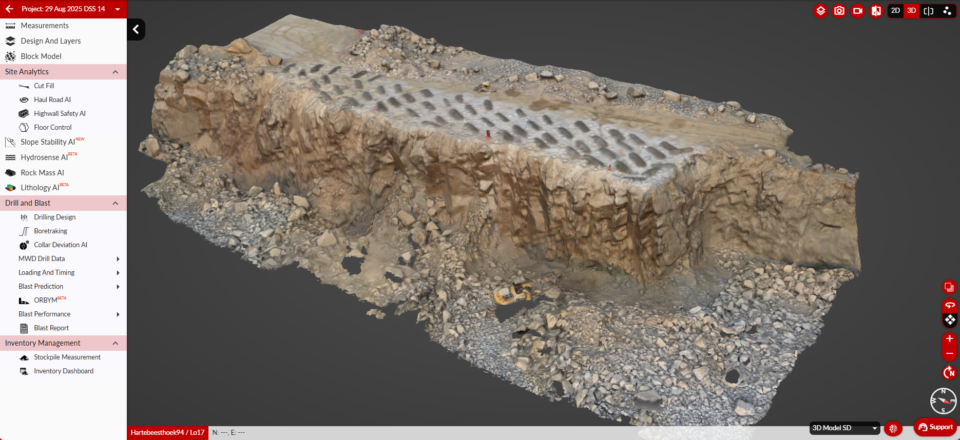
Using drone-based photogrammetry, a three-dimensional (3D) model of the first blast area was created, and a drilling-compliance audit was conducted across the block. The survey took about 10 minutes, while generating the 3D model required approximately 90 minutes.
“The audit showed that the blast geometry – burden, spacing and drilling compliance – was acceptable, revealing that the opportunity was to look at timing to improve fragmentation,” he said.
He explained that, unlike conventional two-dimensional face profiling based on selected cross-sections, the 3D model provided a complete picture of burden across the face and in front of each hole. It identified areas of excess and insufficient burden. “This included a potential corner failure that could have resulted in face burst, flyrock and elevated airblast levels. A significant underburden section behind the failure was also identified, allowing charging to be adjusted before the blast,” he said.
Post-blast, BME used Xplosmart®’s fragmentation AI module to analyse drone imagery of the muckpile. No physical scaling object was required, reducing the need for personnel to enter the muckpile.
Small change, measurable improvement
Hougaard said that the first blast produced a D50 of 509 mm and a D18 of 1,011 mm. “For a quarry feeding a jaw crusher with a defined maximum feed size, such oversize can affect loading, hauling and downstream processing,” he said.
Inter-row timing was shortened by 25 milliseconds to improve interaction between the rows and the crushing and heaving action of the muckpile.
The second block was again modelled in 3D, with BME conducting another drilling-compliance audit, analysing the rock mass using RockMass AI and examining burden profiles.
“An improvement was visible immediately after the second blast, with fewer large fragments evident at the top of the muckpile. Subsequent fragmentation analysis showed that the D50 had fallen from 509 mm to 466 mm, while the D18 decreased from 1,011 mm to 984 mm,” he said.
This represented an 8.45% improvement in D50, a 2.64% improvement in D18 and an overall 11.21% reduction in measured fragment size.
“The D50 change is operationally significant in a quarry environment,” said Hougaard. “A small improvement at the blast can result in a bigger improvement further down the process.”
Further work at the quarry will examine parameters such as burden variability, initiation practices, pattern changes, and burden and spacing, again making incremental adjustments while maintaining powder factor and overall blast costs.
Placing people at the centre
Hariparsad said that while AI is already delivering tangible benefits and becoming an increasingly powerful tool within the mining ecosystem, technology alone does not create value.
“People do,” he said. “For BME, people remain at the centre of this transformation. Better information and insights give mining professionals a stronger basis for applying their expertise, exercising professional judgement and making informed decisions.”
He said that the objective is to strengthen it. “We are helping people make better decisions and unlock greater value from every blast,” he concluded.

Discover more from Africa-Middle East Mining and Energy News
Subscribe to get the latest posts sent to your email.