



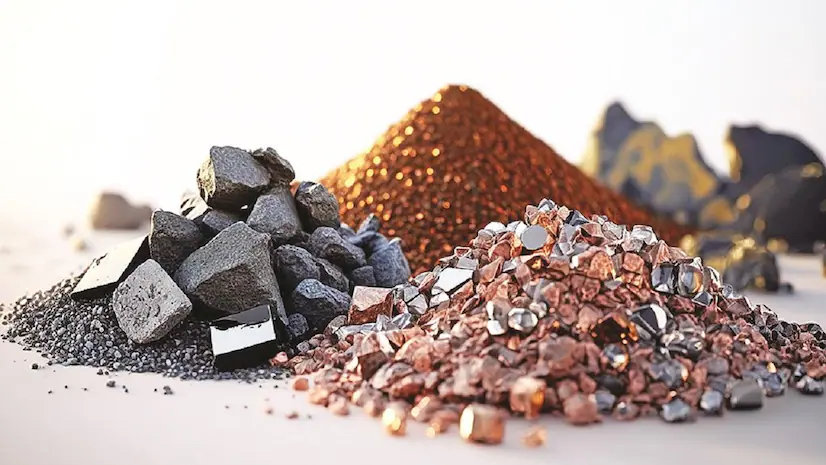
South Africa has taken a “whole-of- government” approach to turning its vast critical-minerals endowment into a strategic advantage for the country, integrating mining, transport, water, trade & industry, as well as energy into an holistic plan to unlock the full potential of the country’s resources.
A high-powered panel featuring several government ministers outlined the approach to an audience of hundreds of investors, delegates and business leaders on Day 1 of Investing in African Mining Indaba 2026 in Cape Town this week.
During an extensive investor-focused presentation and panel discussion, South Africa’s minister of petroleum and mineral resources, Gwede Mantashe, emphasised that the key to developing critical minerals lay in building robust, competitive value chains.
“South Africa must become globally competitive by adding value to our minerals through downstream beneficiation,” he said. “That is where the real benefit lies – for business, for labour, and for our communities.”
Minister of trade and industry Parks Tau reinforced this message, highlighting recent trade agreements with China and the EU, which had moved away from the “pit to port” model, and now specified that industrialisation at source would be a component of the development deal.
The EU-South Africa Clean Trade and Investment Partnership (CTIP), for instance, is designed to ensure that critical minerals mined in South Africa will be beneficiated within the country to support industrialisation and job creation.
Tau also mentioned a recent R100 billion Afreximbank accession agreement that enhances industrial development in South Africa and boosts regional supply chains and intra-African investment flows – in line with South Africa’s economic ambitions.
“This is a programmatic arrangement that allows us to achieve our objectives around critical minerals and the development of local industry,” said Tau.
Mantashe said Tau had been one of the ministers who had coined the term “all-of- government” approach.
“I love that term,” he said. “It’s about breaking out of our silos and doing what’s necessary to achieve our national objectives.”
Water and Sanitation minister Pemmy Majodina pointed out that developing critical minerals would be a water-intensive process, but insisted that those needs could be met.
“South Africa is a water-scare country,” she said. “However, there is enough water. Water is a socioeconomic catalyst, and we must ensure it is shared equitably.”
She said the mining sector already used around 1.8bn litres per day, which made it critical that licensing be efficient to accommodate the needs of the critical- minerals sector.
To this end, water licencing, which used to take three years to finalise, can now be completed online within 90 days. Phase II of the New Lesotho Highlands Water Project has also commenced, boosting the water resources South Africa needs to develop its strategic mineral assets.
Transport minister Barbara Creecy detailed recent freight-policy reforms geared to re-establishing rail as the backbone of South Africa’s cargo-transport space. This has involved bringing in private operators, investment in key freight lines, and the establishment of the Transport Economic Regulator.
The enhanced capacity will supercharge the country’s ability to get beneficiated products to market, as well as to support manufacturing industries in energy and technology.
South Africa has defined critical minerals as those that are of strategic importance to the country. These include its PGM minerals, and resources with green-economy applications, and coal, which remains fundamental to the country’s energy needs, and is a huge employment generator.
In this vein, Samantha Graham-Maré, deputy minister of electricity and energy said the country’s Integrated Resource Plan (IRP) emphasised the need for energy security. Given that coal currently provides around 85% of South Africa’s energy, a just energy transition would need to protect existing jobs while moving towards nuclear, renewables and battery storage.
“The goal is to achieve a stable energy mix that protects livelihoods and facilitates new industries like electric vehicles and battery technology,” said Graham-Mare. “We will transition at a pace and scale that works for our country.”
In an impressive presentation that supported South Africa’s positioning as an essential critical minerals opportunity, Ivanplats-Platreef executive chairperson Patricia Makhesha, showcased the Platreef project, which is projected to become the world’s largest platinum mine.
Makhesha emphasised the new mine’s technology deployment, its skilled workforce, and its 26% community participation.
Tau said South Africa would tether its critical minerals strategy to its energy transition.
“Resources like rare earths are present in South Africa, and have numerous applications in the digital economy,” said Tau.
He said these resources, too, could be linked to the country’s industrialisation effort, based on three pillars – decarbonisation, digitisation and diversification.
“South Africa’s industrial policy is premised on liberating the assets that we hold as a country,” said Tau.
- Investing in African Mining Indaba 2026 is the premier meeting place for African and global mining leaders. The event runs from February 9 – 12 at CTICC 1 and 2 in Cape Town.

Discover more from Africa-Middle East Mining and Energy News
Subscribe to get the latest posts sent to your email.